
⚖️ Important: Legal & Ethical Use
This guide covers AI voice cloning for personal, educational, and parody use. Commercial use of a cloned celebrity voice without written consent can violate right-of-publicity laws (including Tennessee's ELVIS Act and California's Civil Code §3344). Always disclose AI-generated audio on public platforms. Never use cloned voices to deceive, defame, or commit fraud. See the responsible-use section at the end of this article.
AI voice cloning has reached the point where 3 seconds of reference audio is enough to recreate the distinctive style of almost any famous speaker — from Donald Trump's rally-style delivery to SpongeBob's nasal enthusiasm. This guide shows you how to do it for free using Quasar Voice, covers the most-searched celebrity and character voices, and explains how to stay on the right side of the law in 2026.
Why Do People Clone Celebrity and Character Voices?
Over 30,000 people per month search Google for terms like "Trump AI voice," "SpongeBob AI voice," and "Morgan Freeman AI voice." The reasons fall into a few buckets:
- Fan parody and satire — Making short comedy clips, memes, or reaction videos.
- Learning voice cloning — Famous voices are useful benchmarks because everyone recognizes them, so it's easy to judge how accurate a clone sounds.
- Creative projects — Indie games, fan fiction, animation, and podcast skits often use character-style voices.
- Accessibility experiments — Some educators use distinctive AI voices to make content more memorable.
- Technology testing — Developers benchmarking TTS models often test on well-known voices.
All of these uses can be done responsibly with the right tool. Below, we'll walk through how to create celebrity-style AI voices in Quasar Voice, show examples for the most-requested voices, and cover the legal guardrails you need to know.
How AI Voice Cloning Works (The Short Version)
Modern AI voice cloning uses a deep learning model trained on thousands of hours of speech to learn the acoustic "fingerprint" of any human voice. When you upload a short reference clip, the model extracts that fingerprint and applies it to whatever text you want spoken.
Quasar Voice runs on Qwen3-TTS, the open-source model from Alibaba's Qwen team. Key specs:
- 3 seconds of reference audio is enough for a basic clone (15 seconds recommended for best quality).
- 10 languages — English, Chinese, Japanese, Korean, German, French, Russian, Portuguese, Spanish, Italian.
- 8 emotion sliders — Happy, Angry, Sad, Afraid, Disgusted, Melancholic, Surprised, Calm — to shape how the cloned voice delivers any line.
- ~0.95 speaker similarity score — state-of-the-art for open models.
Unlike ElevenLabs, voice cloning on Quasar Voice is free and unlimited — no paid plan required.
How to Create a Celebrity-Style AI Voice in 4 Steps
Step 1: Find a Clean Reference Clip
Look for a 5–15 second audio clip where your target speaker is alone — no background music, no interviewer, no laughter tracks. YouTube interviews, podcast episodes, and audiobook samples are usually the best sources. Export the clip as WAV or MP3.
The quality of the clone depends almost entirely on the quality of this clip. A short, clean 5-second clip beats a 30-second clip with background noise every time.
Step 2: Upload to My Voice Models
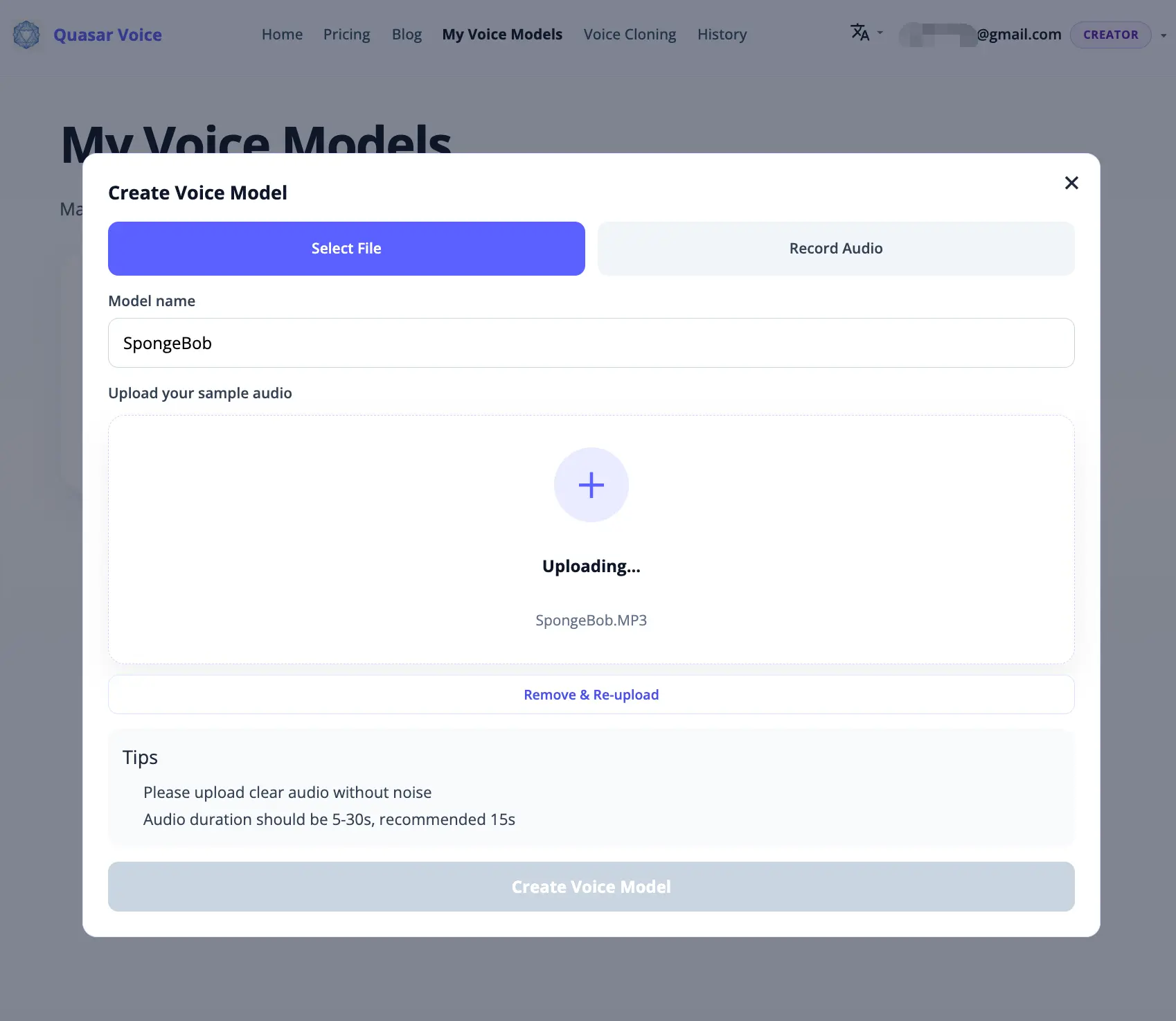
Sign up for a free account at qwen3-tts.ai, then go to My Voice Models. Click Create Voice Model, upload your reference clip, give it a name (e.g., "Political rally style" or "Cartoon sponge"), and click Create Voice Model. The model generates in about a minute.
Step 3: Enter Your Script and Tune the Emotion
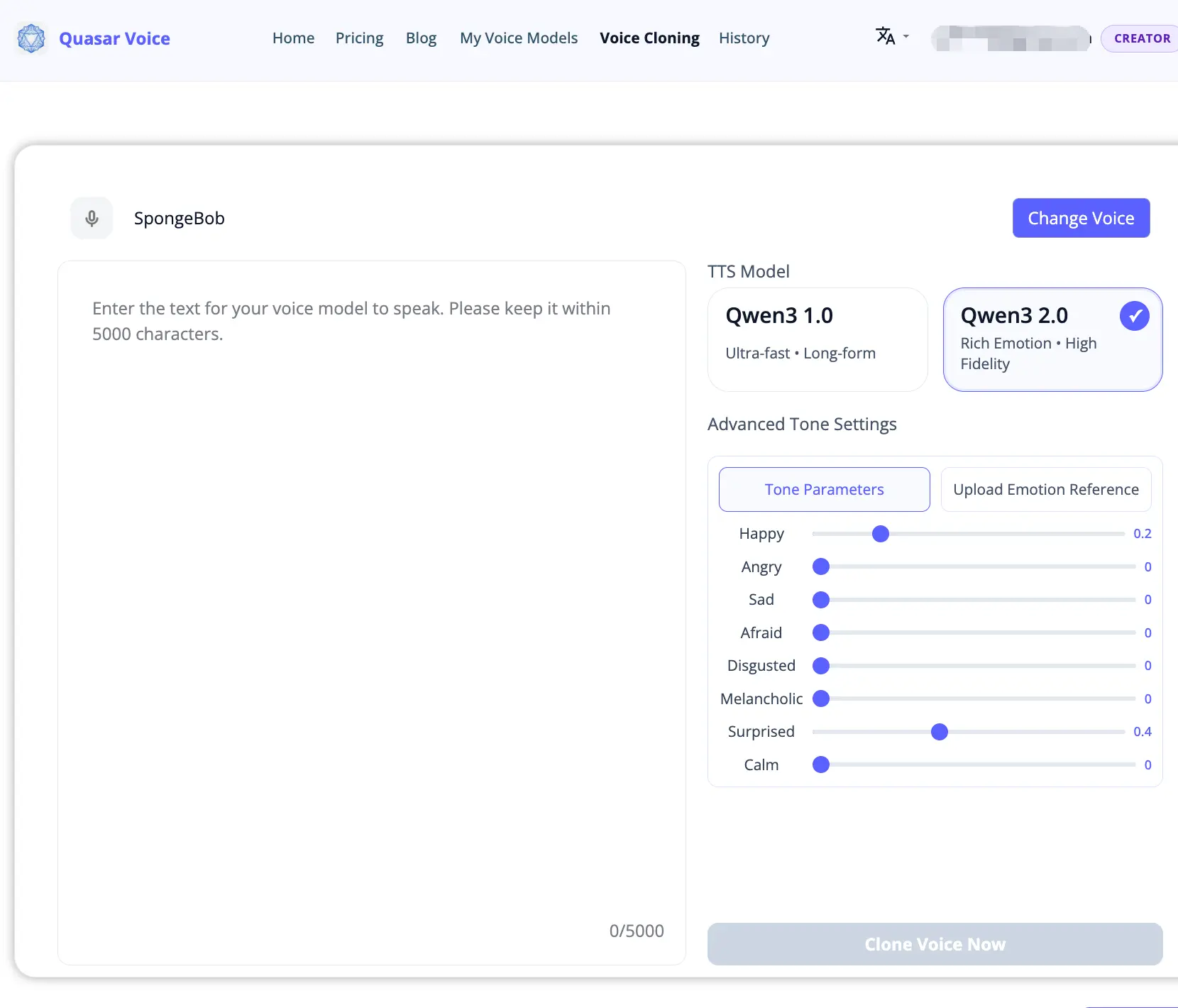
Once the model is ready, click Use to jump to the voice cloning page. Enter the text you want spoken, then:
- Choose Qwen3 2.0 for expressive output (recommended for famous voices with distinctive emotion).
- Adjust the 8 emotion sliders to match the character — for a Trump-style rally speech, bump Angry and Surprised. For a Morgan Freeman-style narration, keep Calm dominant. For SpongeBob, max out Happy and Surprised.
Step 4: Clone and Download
Hit Clone Voice Now. The audio generates in seconds and appears at the bottom of the same page. Preview it, tweak the emotion sliders if needed, and download the WAV file when you're happy.
Popular Celebrity & Character AI Voices to Try
Here are the most-searched voices, what makes each distinctive, and emotion slider settings that get you close to the signature sound.
Donald Trump AI Voice
Monthly searches: ~15,000+ across variants like "trump ai voice," "donald trump ai voice," and "trump voice ai generator." Why it's popular: politically charged content, parody, and news-comedy channels.
What makes the voice distinctive: slow, emphatic delivery; exaggerated superlatives ("the best," "tremendous," "disaster"); rising pitch at key words; strategic pauses for dramatic effect.
Recommended settings:
- Model: Qwen3 2.0
- Angry: 0.3 (background intensity)
- Surprised: 0.5 (for the emphatic peaks)
- Happy: 0.2
Sample text that works well: "We're going to make the best deals this country has ever seen. Nobody knows deals better than me, believe me. It's going to be tremendous."
SpongeBob SquarePants AI Voice
Monthly searches: ~1,600 (KD just 6). Why it's popular: meme culture, TikTok clips, fan fiction, children's content parody.
What makes the voice distinctive: high-pitched, nasal quality; enthusiastic over-articulation; sudden emotional shifts mid-sentence; musical cadence.
Recommended settings:
- Model: Qwen3 2.0
- Happy: 0.9 (maximum)
- Surprised: 0.6
- Afraid: 0.2 (for the comedic panic moments)
Sample text: "I'm ready! I'm ready! I'm ready! Oh boy, oh boy, this is going to be the best day ever!"
Morgan Freeman AI Voice (Deep Narrator Style)
Monthly searches: ~720. Why it's popular: documentary narration, audiobook openings, YouTube video intros, meditation apps.
What makes the voice distinctive: low, resonant tone; deliberate pacing; thoughtful pauses; warm authority.
Recommended settings:
- Model: Qwen3 2.0
- Calm: 0.7
- All other sliders: 0
Sample text: "The ocean stretched endlessly before him, a vast canvas of deep blue that swallowed the horizon. He had been sailing alone for seventeen days."
David Attenborough AI Voice (Documentary Style)
Monthly searches: ~590 (KD 6). Why it's popular: nature documentaries, educational content, wildlife photography reels.
What makes the voice distinctive: hushed, reverent delivery; precise enunciation; gentle crescendo at key observations; upper-class British inflection.
Recommended settings:
- Model: Qwen3 2.0
- Calm: 0.6
- Surprised: 0.2 (for moments of discovery)
Sample text: "Here, in the dense undergrowth of the rainforest, a remarkable creature emerges. Silent. Watchful. Perfectly evolved for its environment."
Barack Obama AI Voice
Monthly searches: ~1,000 (KD 5). Why it's popular: political commentary, speech-writing practice, civic education content.
What makes the voice distinctive: measured cadence; rhetorical rises and falls; deliberate pauses that create emphasis; warm, reassuring timbre.
Recommended settings:
- Model: Qwen3 2.0
- Calm: 0.5
- Happy: 0.2
Peter Griffin AI Voice (Family Guy Style)
Monthly searches: ~1,000 (KD 6). Why it's popular: adult animation fan content, TikTok voiceover memes, Let's Play videos.
What makes the voice distinctive: high-pitched, nasal delivery; Rhode Island accent; exaggerated emotional extremes; signature laugh bursts.
Recommended settings:
- Model: Qwen3 2.0
- Happy: 0.6
- Surprised: 0.4
- Angry: 0.3 (for frustrated moments)
Joe Biden AI Voice
Monthly searches: ~1,000 (KD 11). Why it's popular: political satire, news parody, civic content.
What makes the voice distinctive: gravelly, deliberate delivery; occasional whispered emphasis; personal anecdotal style.
Recommended settings:
- Model: Qwen3 2.0
- Calm: 0.4
- Sad: 0.2 (for the more reflective delivery)
5 Pro Tips for Better Celebrity Voice Clones
- Match the reference clip's energy to your target output. If you want an angry-style delivery, use a reference clip where the speaker is actually emphatic. Reference emotion carries into the clone.
- Keep reference audio under 30 seconds. Qwen3-TTS works best with short, high-quality clips. Longer clips with mixed emotions confuse the model.
- Match the language of your text to the reference audio. A voice cloned from English audio will sound more natural speaking English than Chinese — although Qwen3-TTS handles cross-language cloning better than most competitors.
- Use punctuation to control pacing. Commas, ellipses, and em-dashes create natural pauses. Short sentences with periods produce more deliberate delivery.
- Don't max out every emotion slider. Real voices rarely express more than 1–2 emotions strongly. Setting Happy to 0.8 and Angry to 0.8 produces unnatural output. Pick one dominant emotion with a secondary at 0.2–0.3.
Responsible Use & Legal Best Practices
The legal landscape around AI voice cloning changed rapidly between 2024 and 2026. Here's what you need to know:
The Current Legal Landscape (2026)
- Tennessee's ELVIS Act (2024) criminalizes unauthorized digital replication of a person's voice.
- California Civil Code §3344 treats voice as part of personal identity; commercial use without consent carries civil penalties.
- US AI Transparency and Voice Rights Act (2026) requires disclosure when AI-generated voices appear in commercial contexts.
- EU AI Act mandates labeling of AI-generated audio.
- Right of publicity laws (varies by state) protect celebrities from unauthorized commercial use of their likeness, including voice.
What's Generally Okay
- Cloning your own voice for your own content.
- Personal, non-commercial experimentation and learning.
- Clearly labeled parody or satire (protected in most jurisdictions, but with limits).
- Creating voices for fictional characters you own.
- Educational demonstrations with disclosure.
What's Risky or Illegal
- Using a cloned celebrity voice in advertising without consent.
- Creating content that could mislead viewers into thinking a real person said something they didn't.
- Monetizing content featuring a cloned celebrity voice without permission.
- Impersonation for fraud, scams, or defamation (criminal in most jurisdictions).
- Political deepfakes in campaign contexts (restricted in many US states).
The Four Rules We Recommend
- Disclose. Always label AI-generated audio when sharing publicly. YouTube, TikTok, and Meta all require it.
- Never deceive. Don't put words in someone's mouth that could reasonably be mistaken for real.
- Get consent for commercial use. If money is involved — ads, paid content, products — get written permission from the voice owner.
- Keep it parody, not propaganda. Clear satire is protected speech in most places. Realistic impersonation for political manipulation is not.
This article is for informational purposes and is not legal advice. Laws vary by jurisdiction and change frequently. Consult a lawyer for specific projects, especially anything commercial.
Why Quasar Voice Is the Best Free Option
Most AI voice platforms either charge for voice cloning (ElevenLabs requires a $5+/month plan) or limit free users to 1 clone per month (Play.ht). Quasar Voice is different:
| Feature | Quasar Voice (Free) | ElevenLabs (Free) | Play.ht (Free) |
|---|---|---|---|
| Voice cloning | Unlimited | Not available | 1 clone/month |
| Emotion control | 8 sliders | Paid only | Limited |
| Commercial rights | Included | Paid only | Paid only |
| Free characters/month | 10,000 (~18 min) | 10,000 (~10 min) | 12,500 |
| Reference audio needed | 3 seconds | ~30 seconds | 30 seconds |
| Open source | Yes (Apache 2.0) | No | No |
For a deeper comparison, read our best ElevenLabs alternative guide.
Frequently Asked Questions
Is it legal to clone a celebrity's voice with AI?
For personal, educational, or clearly-labeled parody use — generally yes in most jurisdictions. For commercial use (ads, monetized content, products), you need written permission from the voice owner, or you risk violating right-of-publicity laws in states like California, Tennessee (ELVIS Act), and New York. Always disclose AI-generated audio on public platforms.
What is the best free AI celebrity voice generator?
Quasar Voice is the best free option — it offers unlimited voice cloning, 8 emotion sliders, and commercial rights on the free plan. It runs in your browser with no GPU or local setup, and the underlying model (Qwen3-TTS) is open source.
How much audio do I need to clone a voice?
Just 3 seconds of clean reference audio is enough for a basic clone. For best quality, use a 15-second clip with clear speech, no background music, and no overlapping voices.
Can I make a Trump or SpongeBob AI voice for free?
Yes. Quasar Voice's free plan lets you upload a reference audio clip of any public figure or cartoon character and clone the voice unlimited times. Keep usage to personal, educational, or parody contexts, and disclose AI-generated audio when sharing publicly.
Can I sell content made with a cloned celebrity voice?
Not without written permission from the voice owner or the rights holder. Commercial use of a cloned celebrity voice without consent violates right-of-publicity laws in most US states and EU member countries. For commercial projects, either get explicit consent or create original voices using Quasar Voice's voice cloning with your own or a licensed reference audio.
Why does my clone sound slightly different from the original?
A few reasons: (1) reference audio quality — background noise, music, or overlapping voices degrade the clone; (2) emotion mismatch — if the reference is calm but your text requires anger, the model has to infer; (3) language mismatch — cloning from English audio but generating Chinese produces slight accent drift. Try using a cleaner reference and matching the reference emotion to your intended output.
Start Creating — Free
Sign up for Quasar Voice and clone your first celebrity-style voice in under a minute. Unlimited clones, 8 emotion sliders, commercial rights — all free, no credit card.
Try Quasar Voice Free →